Problem Software Action Plan: legal partnership with Louwers Advocaten
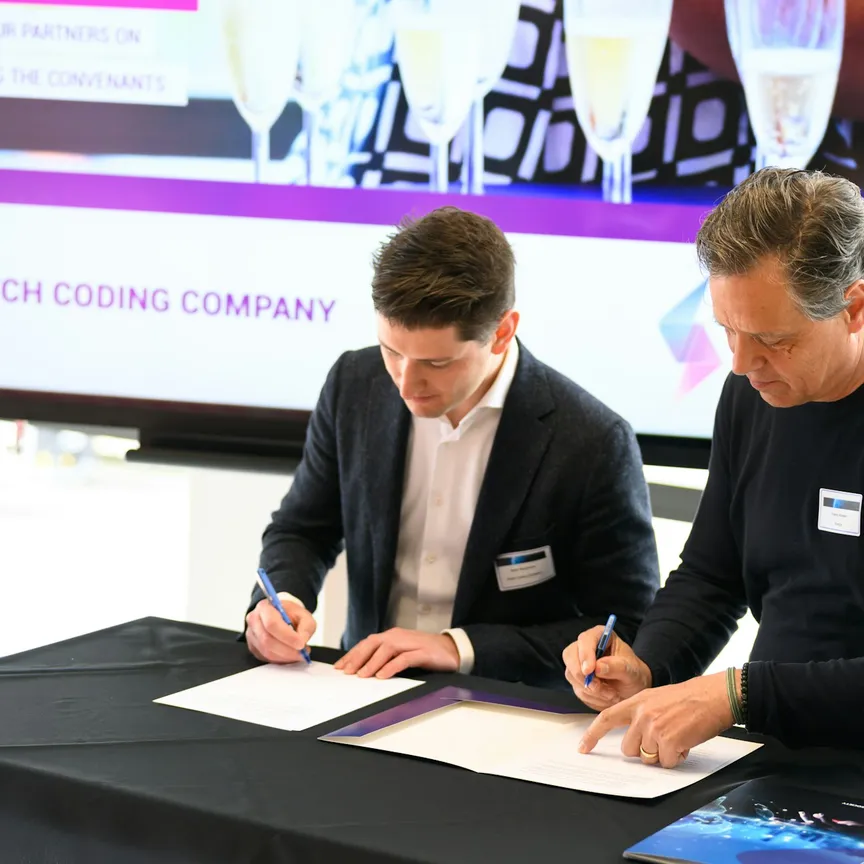
Dutch Coding Company is partnering with Louwers IP & Tech Advocaten. Together we are launching the Problem Software Action Plan, for business owners whose collaboration with their software developer has broken down. Because if you want to know whether you can collect damages with your previous supplier and how to continue development afterwards, you need both a lawyer and a developer.

When the relationship with your developer breaks down
Is your software project stuck? Is your IT supplier failing to keep its promises? Are costs rising while results fail to materialise? A conflict with your developer costs a lot of time, money and energy. In the worst case, it puts the continuity of your app or platform at risk.
During these difficult times you face a complex choice: do you sue your supplier, make one more attempt to reach a solution, or try to salvage what can be salvaged? To make the right decision, you need insight into where you stand: both into your legal position and what has and hasn't actually been delivered technically.
At Dutch Coding Company, we see these situations more often than we'd like. We specialise in taking over, rescuing and fixing stalled software projects, from mobile apps to web platforms and customer portals. In a conflict with a previous developer, we often find that the technical side is only half the story.
Partnership with Louwers IP & Tech Advocaten
That's why we're proud to announce our partnership with Louwers IP & Tech Advocaten, specialists in IT law. Two Eindhoven-based companies, each with their own background and expertise, but both focused on technology. Together, we help business owners regain control of stalled software projects.
Our approach starts with the Problem Software Action Plan: a combined legal and technical analysis for companies that are in, or heading towards, a conflict with their software supplier.
Legal and technical analysis complement each other
In an IT conflict, lawyers talk about contracts and developers talk about code. The problem is that the two constantly influence each other. Whether there has been a breach of contract depends not only on the agreements with your supplier, but also on what has and hasn't been delivered technically. And whether you can continue development of your current code or need a full rewrite has a direct impact on the continuity of your app, and on whether you can recover any costs or damages.
Yet in practice, we often see only one of the two sides being considered. Some business owners quickly cut their losses and immediately look for new developers to take over. Others refuse to accept it and start a legal battle, but miss hidden defects in the code. Only by looking at both the technical and the legal side do you get a clear answer to both questions: can I claim anything from my previous developer, and how can I start shipping code again as quickly as possible?
By working on the case together from the very start, the legal and technical analyses are aligned. Technical findings support your legal position, and the right legal approach ensures the smoothest possible handover to a new developer.
How does the Problem Software Action Plan work?
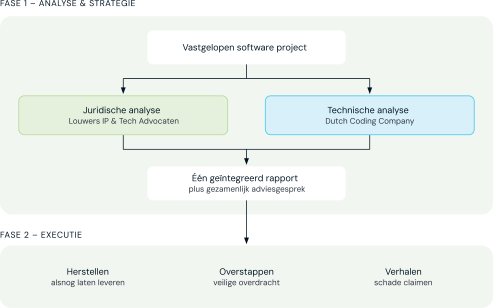
The action plan starts with a thorough analysis of your situation, from both perspectives:
- Legal analysis: Louwers maps out your legal position. What was agreed with your supplier? What obligations do they have? How do you safeguard continuity during a handover? And can you recover (part of) the costs or damages from your supplier?
- Technical analysis: we test the contract against the technical reality. We assess the source code, the architecture, the chosen solution and the hosting. Is the previous development agency refusing access? We can often make an initial assessment from the outside. We check whether the software meets professional standards, to what extent the agreed functionality has been delivered, and whether there are urgent security or continuity risks.
- One report and advisory meeting: we combine both analyses into a single report, in which the technical findings have already been translated into your legal position. In a personal meeting, we explain the conclusions and give you concrete advice on the best next steps.
Where possible, we agree on one fixed price for the complete analysis in advance, so you know exactly where you stand. That's a welcome change at a time when the costs of your project have already become unpredictable.
Problem Software Action Plan
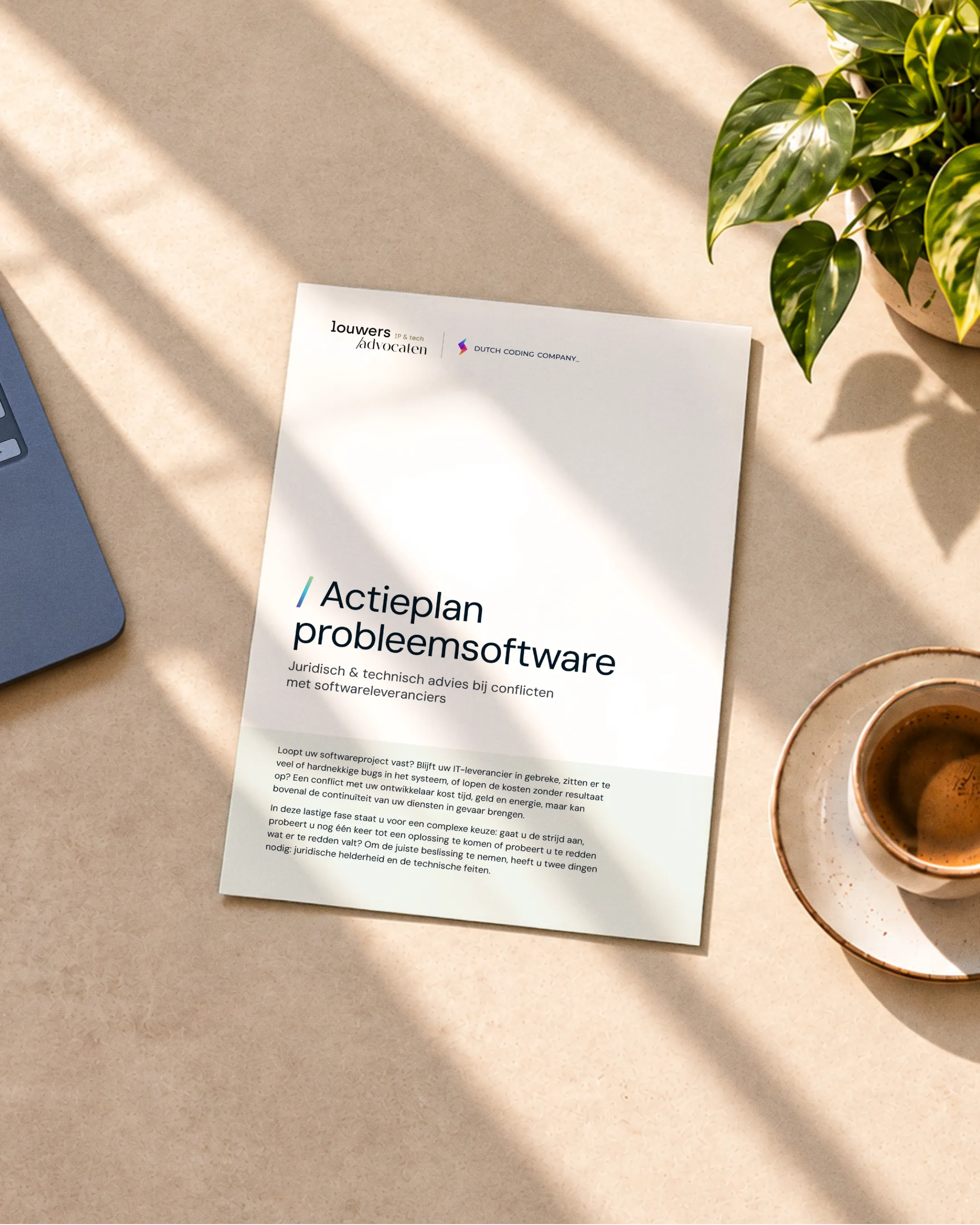
Want to know more about the Problem Software Action Plan? In this brochure (in Dutch), we explain how Louwers IP & Tech Advocaten and Dutch Coding Company analyse your project from a technical and legal perspective.
Next steps
With the report in hand, you choose the route that fits your situation: pressing your supplier to deliver after all, recovering (some) damages, reaching a pragmatic settlement or switching to a new development partner. Often it's a combination, and it pays to quickly work towards a solution to prevent downtime. After all, your customers won't notice a legal conflict, but they will notice an app that no longer works.
That's why we take immediate action where needed. Louwers can remind your supplier of its duty of care, so that the service doesn't come to a standstill during the process. At the same time, we help secure the code, data and servers and bring them under your own control. Where necessary, we fix critical bugs or security risks.
If you opt for a handover, we're ready to take over the project. The people who assessed your code are also the people who will continue developing the project. That way, you don't have to start searching again and explain where the problems lie. For the takeover, we follow a fixed approach:
- Defining goals: what does your software actually need to do for your business and your users? Not everything that was ever in the backlog is still relevant today.
- Stabilising: putting out the fires first. Fixing critical bugs, getting security in order and making sure everything runs reliably again.
- Modernising: tackling technical debt, updating outdated components and introducing modern tooling that lets you pick up speed again.
After that, you're back where you wanted to be from the start: in a position to develop new features quickly and keep pace with market demand.
Curious about your options?
Is the collaboration with your current developer stalling, or are you unsure whether you're still on the right track? Get in touch for a no-obligation introduction. Together with Louwers, we'll see whether the Problem Software Action Plan can help you move forward.